
Carbon Feeds the Soil
The previous two posts in this series followed carbon into the soil's structure, where it holds water and nutrients within reach of roots. Building that structure is the work of living organisms, and they run on carbon. Soil organic carbon feeds the microbes and fungi that keep the whole system working.
The soil runs on carbon
Healthy soil is full of life, most of it invisible to the human eye, with a single handful holding billions of microorganisms. Nearly all of it runs on carbon. Bacteria, fungi, and the rest draw their energy from organic matter: root exudates, residue from cover crops, manure from creatures big and small, and everything else that has lived or died in the ground. When carbon inputs stay steady, the community is active. When they thin out, it slows.
That community does more than feed itself. As microbes break down organic matter, they convert nitrogen, minerals and trace nutrients into forms that crops can absorb. They also build.
Life builds the structure
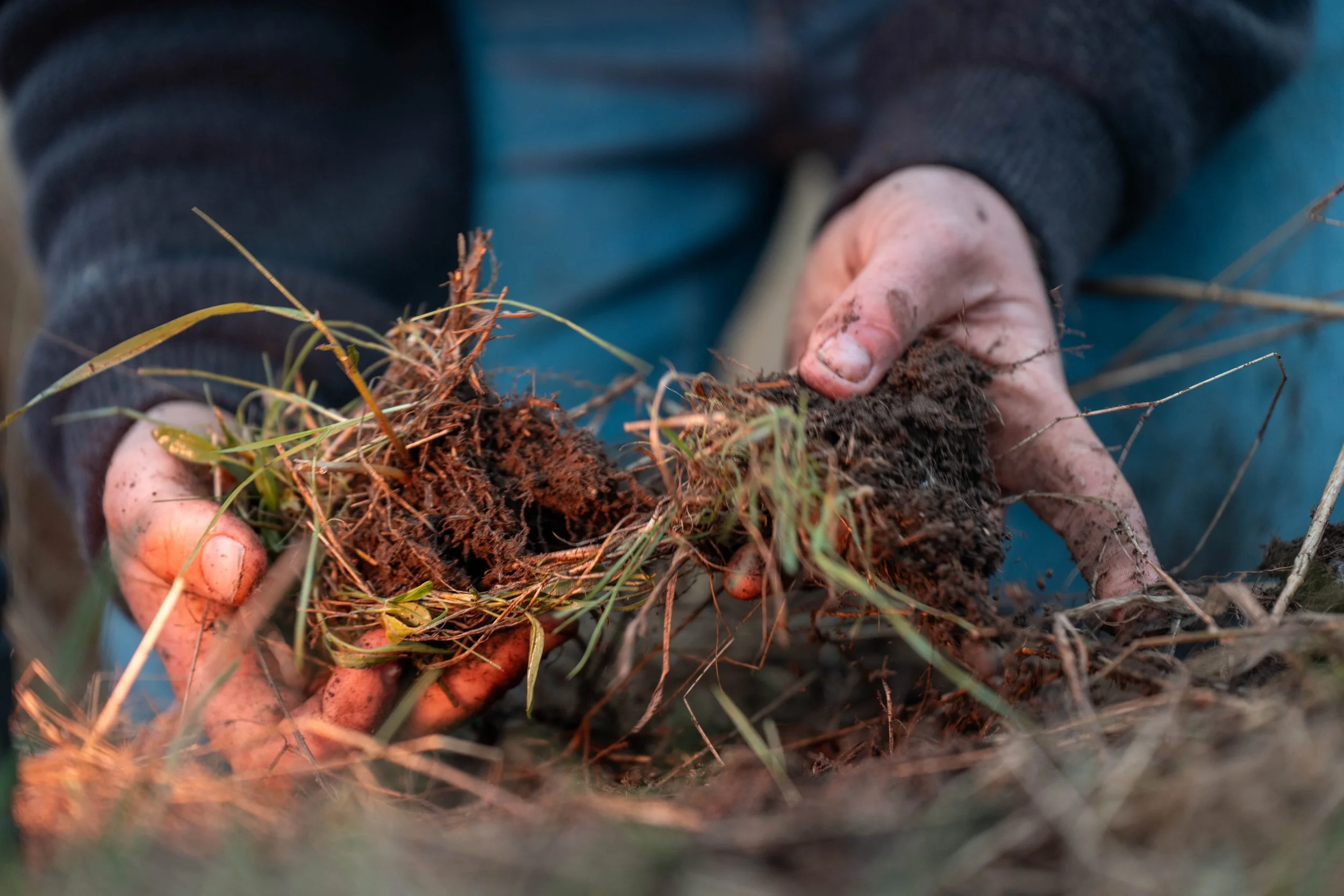
Much of what holds soil together is biological. As microbes feed, they produce sticky compounds (glomalin) that bind fine mineral particles into clumps, and fungal threads called hyphae grow through the soil and enmesh those clumps into larger aggregates. Aggregates are the crumb structure that allows water to infiltrate and roots to move through the soil profile. Biology is quietly building the structure that moves water and nutrients. Those aggregates then wrap around organic matter and shelter it, which is part of how biological activity turns into stored carbon.
Some of those fungi partner directly with the vine or tree. Mycorrhizal fungi extend threads far beyond the reach of the roots and return water and nutrients to the plant in exchange for carbon.
Feeding that biology builds more of it. In field studies, adding organic matter raised microbial biomass and drove the formation of large aggregates alongside gains in soil carbon.
The loop closes
Each step drives the next. Carbon feeds the microbes and fungi. Those organisms build aggregates. Aggregates shelter carbon inside them, where it breaks down more slowly, and the spent microbes themselves become part of the soil's stable carbon. That protected carbon, along with the next season's inputs, feeds the biology again.
The loop is not automatic. Microbes also consume the compounds that bind aggregates together, and a flush of fresh carbon can speed the breakdown of what is already in the soil. What tips the balance toward building is steady input over time rather than a single amendment.
Permanent crops have an edge
A permanent crop gives the soil something an annual rotation cannot: years of undisturbed ground and a standing root system. Living roots release carbon directly into the soil around them, feeding the organisms in the root zone, and they do it across the full year rather than a single season. Tillage works against the same community, breaking apart the aggregates and fungal networks that are built over years.
The benefits of implementing permanent cover and low-till management to store soil carbon and improve soil health have been documented in many studies, including California research on permanent crops. In mature almond orchards, compost additions raised soil biological activity along with organic carbon. Keeping roots in the ground and disturbance low gives that underground community the two things it depends on: a food supply and a stable place to live.
The bottom line
Living soil builds over seasons. How much it gains depends on what you start with. Perennial cover is one of the surest ways to keep carbon flowing to the biology year round.
AMP grant funding available through the Oakville Bluegrass Cooperative will help you make that transition to permanent cover and longterm soil health. We can cover the cost of the first ten acres of perennial seed so you can put living roots in the ground and keep the soil fed. This year's applications close August 28th. Reach out today.
---
Further reading:
Organic amendments drive soil organic carbon sequestration and crop growth via microorganisms and aggregates, Agronomy, 2025
. Climate smart management practices add value to mature organic almond production system, Frontiers in Sustainable Food Systems, 2025.
Perenniality impacts on soil physical and hydraulic properties and ecosystem services: a review, Sustainability, 2025.
Rasse, Rumpel, and Dignac, Is soil carbon mostly root carbon? Mechanisms for a specific stabilisation, Plant and Soil, 2005.