
Carbon Holds Nutrients
Last week we looked at how carbon holds water. Carbon also keeps nutrients where crops can use them. Calcium, magnesium, potassium, and other nutrients move with water through the soil, and on lighter soils a heavy rain or a long irrigation can carry them below the root zone before the crop takes them up. Building soil organic carbon is the main lever a grower has to slow that loss.
How soil holds a nutrient
Most of the nutrients a crop needs travel through the soil as positively charged ions, or cations. Clay and organic matter carry a negative charge on their surfaces, so they attract and hold those cations instead of letting water carry them off. However, that holding power has a limit. When water moves through faster than the surfaces can hold on, cations are pulled loose and washed down past the roots, which is how nutrient leaching occurs.
The measure of how much a soil resists that loss is its cation exchange capacity. Sandy soils sit at the low end of that scale, and clay and organic-rich soils much higher. Organic matter itself carries a high capacity, higher by weight than most of the mineral fraction, so raising it lifts the whole soil's capacity to retain nutrients.
Once attached to those surfaces, nutrients stay available rather than locked away. A root draws a cation off an exchange site as it needs it, and the site refills from the soil solution. The same exchange buffers the soil chemistry, so pH and nutrient availability vary less with every rain and every application, and nutrients release gradually rather than all at once.
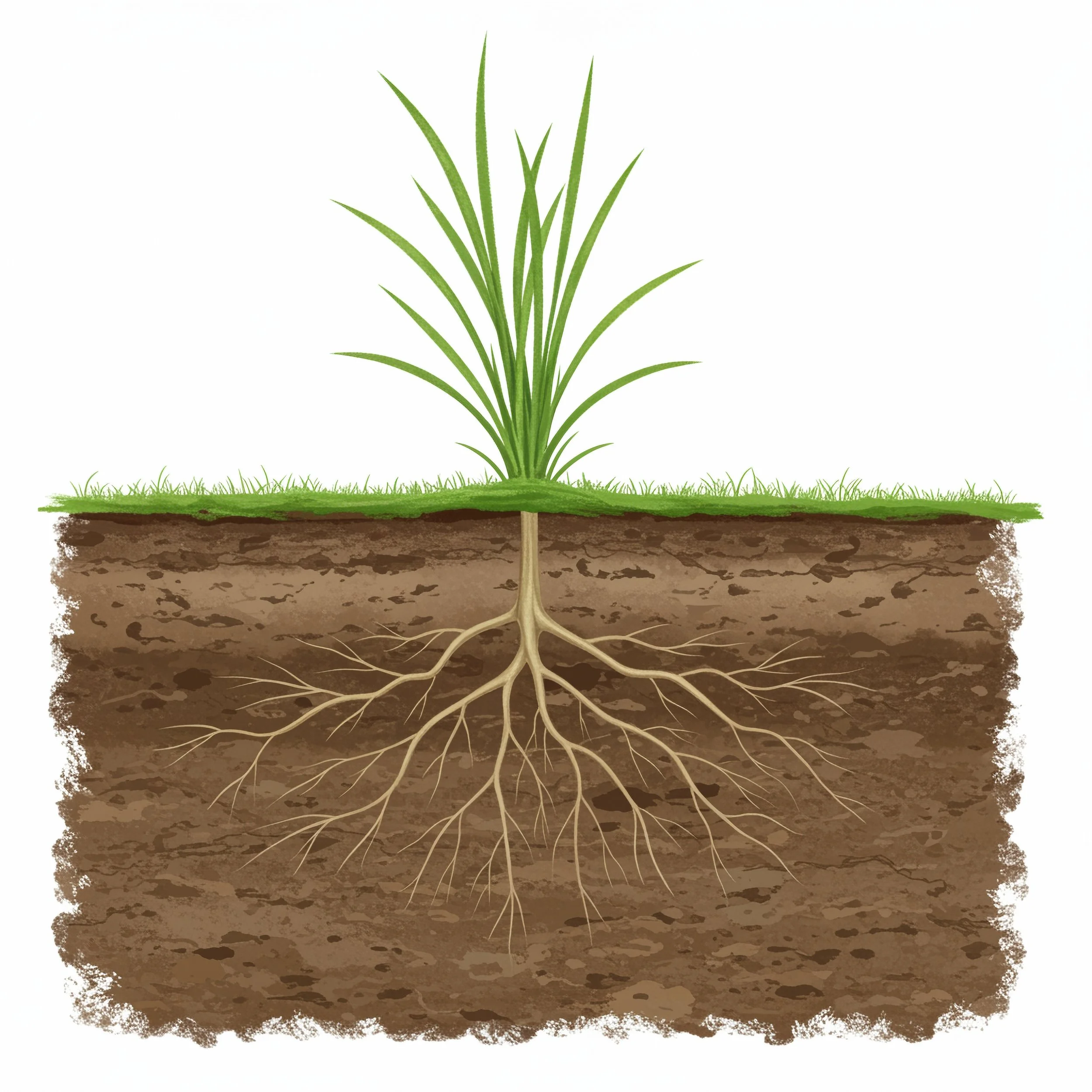
Where organic matter matters most
A soil's baseline capacity to hold nutrients is set largely by its clay content and mineralogy, which a grower cannot change. Organic matter is the part that responds to management. On heavy ground with plenty of clay, it adds to an already substantial capacity. On sandy or coarse ground, where there is little clay to hold nutrients, organic matter does most of that work, and the soil depends on it to keep nutrients in the topsoil.
Much of California's permanent-crop acreage sits on coarse alluvial ground, and on those soils the organic carbon a grower builds carries a large share of the nutrient retention. More of the calcium, magnesium, and potassium already present stays within reach of roots, and more of what gets applied stays available long enough to be used rather than lost below the root zone. That can mean less nutrient leaching and more even availability between applications. Where inputs are costly and losses come easily, stored soil carbon benefits the system by reducing nutrient losses.
The living side of the same story
Nutrient retention runs on more than charge. Soil organic carbon is also the energy source for the microbes and fungi that cycle nutrients. As they break down organic matter, they release nitrogen and other nutrients in forms crops can absorb. California research outlines the value for permanent crops: in mature almond orchards, compost additions raise soil biological activity along with organic carbon. As that biology works, it also helps build the structure that governs how water and nutrients move through the profile. Both processes run on the same carbon, which is why carbon-rich soils tend to feed a crop more evenly.
That carbon also shapes how the soil handles water. The structure behind infiltration and water retention comes from the organic matter that holds nutrients, so the two gains complement each other.
What it takes
Soil organic carbon builds progressively over time, with each season adding more to the total stock. It works within what a soil's texture allows, not beyond it. Living roots are the most reliable way to keep carbon accumulating, and perennial cover keeps them feeding the soil year round rather than for a single season. A current soil test, with a cation exchange value, gives a baseline measurement.
AMP can help you make the transition to continuous living roots, covering the cost of perennial cover seed so you can start building the carbon that holds nutrients and water in place. This year's applications close August 28th, so reach out soon.
---
Further reading: Cation exchange capacity fact sheet, soilquality.org.au
Climate smart management practices add value to mature organic almond production system, Frontiers in Sustainable Food Systems, 2025