
Carbon Holds Water
Organic carbon yields multiple positive effects in orchards and vineyards, acting as a foundational driver for structure and moisture management. By binding mineral particles into stable aggregates, it not only regulates infiltration but also enhances the water-holding capacity within the active root zone. Increasing organic carbon leads to increased capture of rainfall (and irrigation!) and greater moisture retention, providing a critical buffer for perennial crops through the growing season.
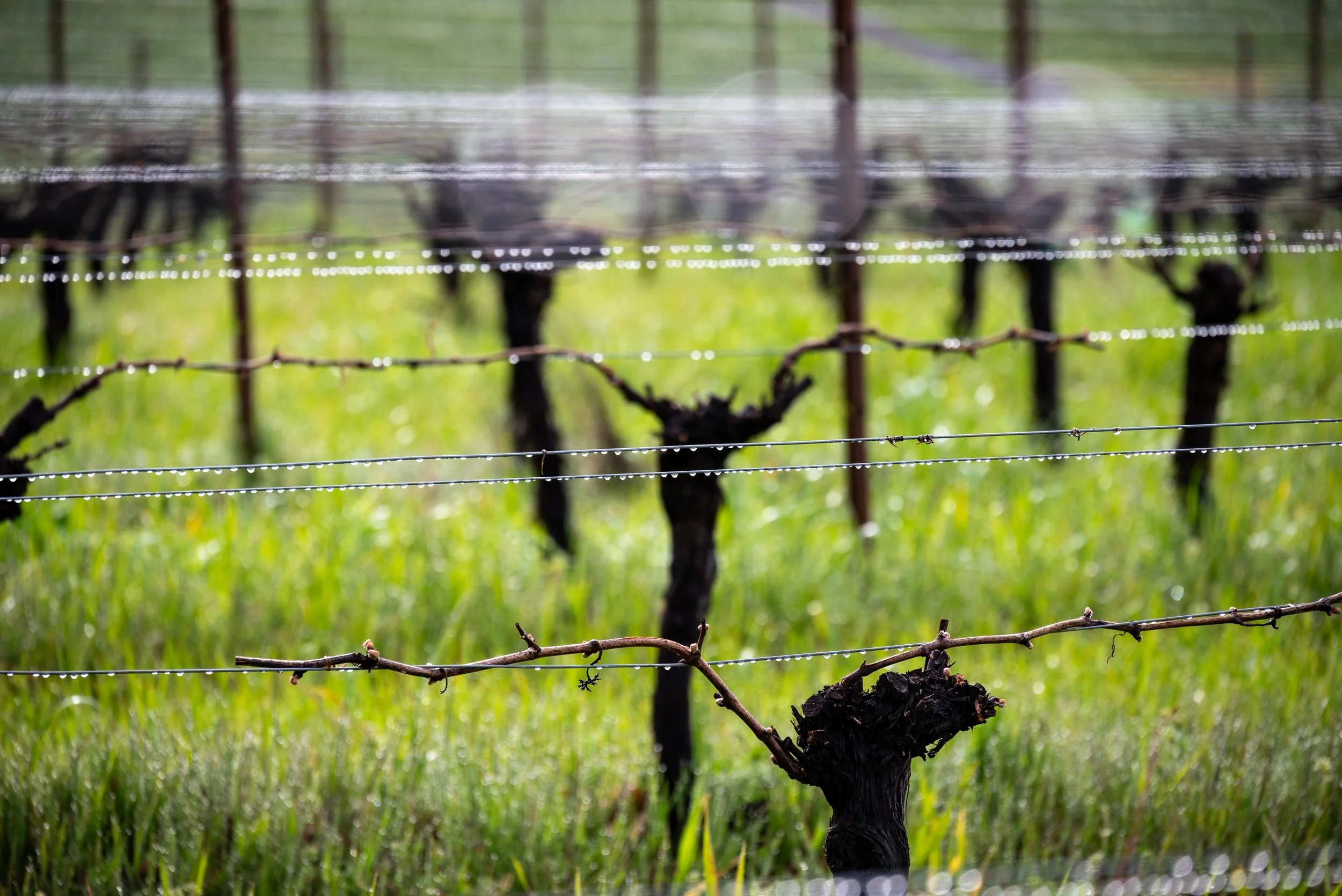
Aggregates shape infiltration
Soil organic carbon is the primary agent that’s binding mineral particles into stable aggregates. A 2024 study in the European Journal of Soil Science, which tested aggregate stability across land uses, identified soil organic carbon as the major driver of that stability. Aggregate stability in turn influences surface erosion, water infiltration, plant growth, and carbon stabilization.
Structure creates pore continuity. Well-aggregated soil holds a connected network of pores across a range of sizes, with larger pores moving water down into the soil and smaller pores trapping moisture within reach of roots. Where soil lacks that structure, aggregates break down under rain or irrigation and their fine particles crust over the surface, so water runs off instead of soaking in.
A 2025 review in Sustainability, drawing on literature from 1997 forward, reported that continuous organic matter inputs improve aggregate stability, reduce compaction, and raise both infiltration and retention.
Perennial roots feed the system year-round
Roots are a principal pathway for carbon entering mineral soil, and root-derived carbon tends to persist longer than carbon delivered from surface residue (compost). One analysis across available studies estimated the mean residence time of root-derived carbon at 2.4 times that of shoot-derived carbon. Perennial cover keeps those pathways active across the full year rather than through one growing window.
Field data from California vineyards points the same direction. A 2022 study in Frontiers in Environmental Science measured net ecosystem carbon balance across vineyard sites and found the sites studied functioned as net carbon sinks. On finer-textured soils, keeping living cover in place and reducing tillage improved net carbon storage, with the largest gains under the higher-biomass cover crops.
Structured soil is a reservoir
The structure that moves water into the soil also holds it there, which matters because California growing seasons see extremes. In winter, rain arrives faster than the surface can absorb it. In summer, none comes for months. Well-aggregated soil rich in root-derived carbon, supports both infiltration and moisture holding, when most needed.
When a heavy rain falls, a connected pore network absorbs it rather than shedding it. Water that infiltrates moves down into the soil profile, in a process known as percolation. Poor structure does the reverse, sealing over at the surface and sending water and topsoil downslope as runoff, and erosion.
Through the dry months, the finer pores within that structure hold moisture between rains or irrigations. Organic matter contributes to that reserve, keeping water available in the root zone longer. For a permanent crop that has to hold ground through a long dry summer, the value shows up in how far each irrigation goes. Do you want to start irrigating later, and stretch the time between irrigation events? Increasing organic carbon will help you achieve these goals, especially if it’s coming from living roots.
The bottom line
Carbon builds aggregates. Aggregates open and stabilize pore space. Pore space determines how much applied, received and stored water reaches the root zone. Each of the downstream benefits, from erosion resistance to nutrient retention, traces back to the same structural foundation. The gains compound, since improved structure supports the root activity that supplies the next season's carbon.
The Oakville Bluegrass Cooperative has $3.5M in funding via a USDA grant, to help you put roots in the ground year-round and build soil carbon. We carry the administrative load for grant processing, but need you to start the process with us by August 28th, for a Fall 2026 planting. Reach out ASAP to get started.
.---
FURTHER READING
Poeplau et al., "Land use and soil property effects on aggregate stability assessed by three different slaking methods," European Journal of Soil Science (2024). https://bsssjournals.onlinelibrary.wiley.com/doi/10.1111/ejss.13549
"Site characteristics determine the effectiveness of tillage and cover crops on the net ecosystem carbon balance in California vineyard agroecosystems," Frontiers in Environmental Science (2022). https://www.ncbi.nlm.nih.gov/pmc/articles/PMC9732729/
"Perenniality Impacts on Soil Physical and Hydraulic Properties and Ecosystem Services: A Review," Sustainability (2025). https://www.mdpi.com/2071-1050/17/24/10988
Rasse, Rumpel, and Dignac, "Is soil carbon mostly root carbon? Mechanisms for a specific stabilisation," Plant and Soil (2005). https://doi.org/10.1007/s11104-004-0907-y