
Growing Cover with Millborn Seeds: Choosing a Cover That Fits Your Goals
This is the fifth and final conversation in our Growing Cover series, where we talk about putting perennial cover to work in orchards and vineyards. This time we sat down with Justin Fruechte of Millborn Seeds, a full-line seed house whose catalog of natives, cover crops, and perennial grasses runs deep enough to build almost any mix imaginable.
Founded in 1987, Millborn works out of Brookings, South Dakota, with a network of processing facilities and contract growers serving roughly three and a half million acres a year across the United States and Canada. Their reach includes truckload orders for seed companies down to one-pound bags of pollinator mix for backyard gardeners, backed by a specialist team in conservation, reclamation, forage, and cover crops. Most relevant for West Coast growers, Millborn recently acquired Clearwater Seed in Spokane, Washington, a Pacific Northwest hub stocked with nearly the full Brookings inventory. Because the AMP grant reaches California, Oregon, and Washington, that West Coast inventory cuts freight cost and time while adding real capacity to move seed to growers who need it.
Here are five key ideas for West Coast growers thinking about perennial cover.
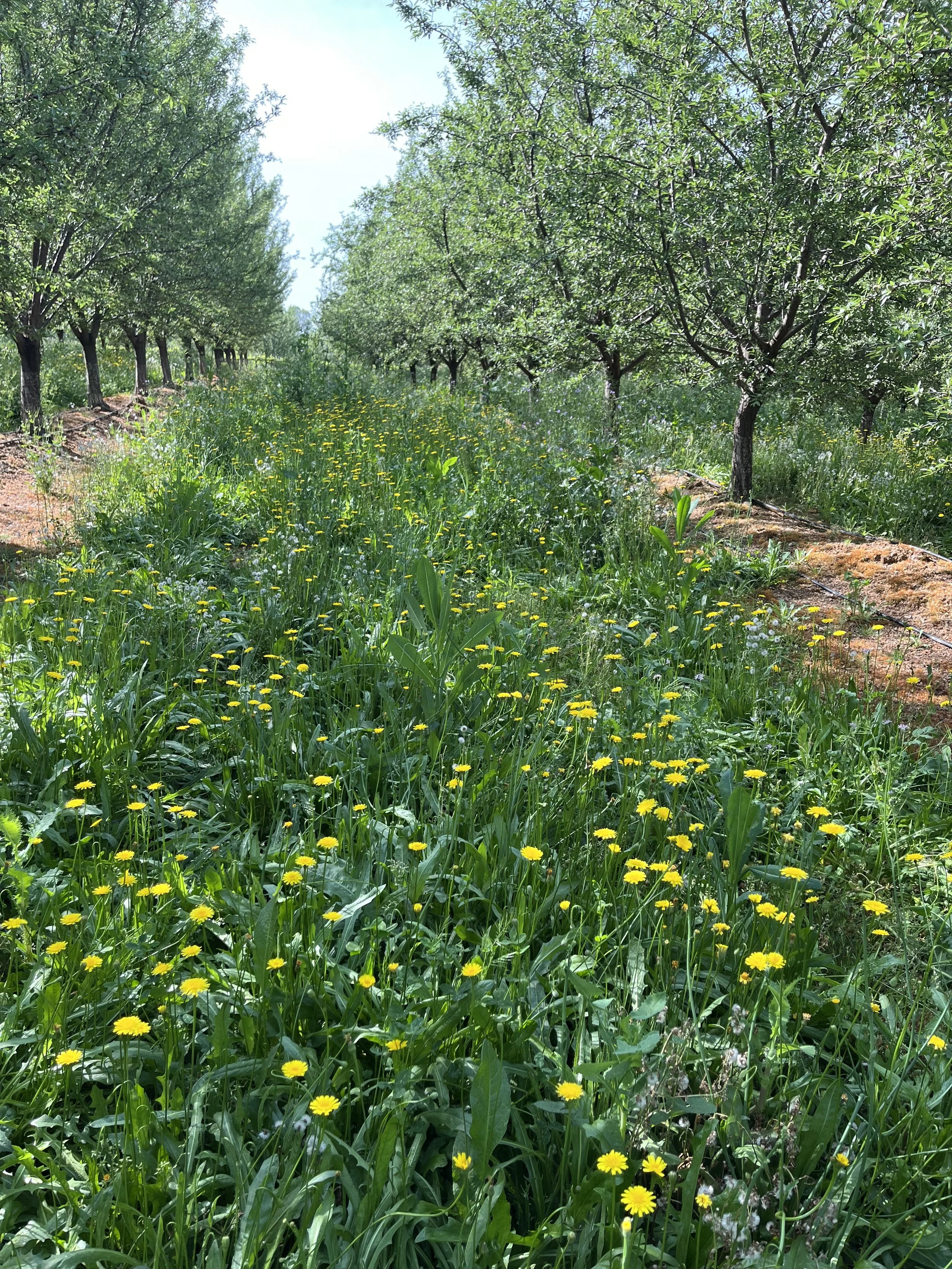
1. Three ways to cover the ground
Millborn presents three options for covering the ground, and knowing the tradeoffs for native or introduced species is a good starting point for any plan. Introduced grasses such as bromes, fescues, ryegrasses, and bluegrasses, originated in Europe and have been bred for performance and vigor. Native species are known to have challenges for early vigor and competitiveness and are more sensitive to regional soil and temperature considerations. Both have a place, depending on the goals.
An annual mix grows quickly, covering the soil and suppressing weeds. If the blend includes legumes like clover or vetch, it fixes nitrogen too, building fertility along the way. It is the workhorse for a short-term contract or for prepping tired ground before a long-term planting goes in.
An introduced perennial mix is built on cool-season grasses, most often creeping, chewings, and hard fescues, sometimes with a little white Dutch or red clover. These establish fast and deliver usable ground cover in the first year. Fescues also tend to be economical per pound, so even at a heavier seeding rate a fescue-based project can come in cheaper than natives.
A native perennial mix is the long game. Short, hardy, long-lived species like blue grama, buffalo grass, sideoats grama, and little bluestem top out around two feet and ask very little once established. Natives do require patience as they have low seedling vigor, compete poorly against weeds early on, and usually do not look like a satisfying stand until year two. The payoff is drought resilience and a plant-it-once cover that suits an orchard or vineyard floor.
2. Start with goals and guardrails
OBC doesn't prescribe a fixed five-species mix for the grant, because every situation is different. A better approach is to name the guardrails and the goals first: maximum height, early-spring flowering, summer dormancy, and so on. From there, a custom mix can be built to match.
Once the species are chosen, the ecoregion determines which varieties to use. Plant species have genetically different ecotypes that thrive in different growing regions, depending on environmental factors like climate, soil and elevation. Sideoats grama is a good example, with northern types like Pierre and Butte and a southern type like El Reno. What thrives in California will not necessarily thrive in South Dakota, so matching variety to location matters as much as picking the species. Millborn builds each blend from a regional sheet that pulls only the varieties suited to the planting area, the same way they spec an NRCS or CRP plan.
3. Why short, cool-season cover fits orchards
Growers moving off a heavy soil builder mix tell us the same thing: they want the roots, not the biomass. A legume- and brassica-heavy annual cover can reach four or five feet, peaking in March and April when growers most need access to the rows, leaving a heavy stand to mow and clear. Short, low-vegetation grasses solve that, staying out of the way while keeping living roots in the ground.
There is a potentially overlooked benefit to low cover. Tall, dense cover raises the humidity layer in the orchard, from the first eighteen inches up to four feet, well into the canopy, increasing the risk of fungal infection. A lower cover keeps that layer down. It is the same principle behind widening soybean rows to fight white mold: more airflow, less disease.
The other piece is timing. Most orchard and vineyard growers want the cover to go dormant in the summer, when water is precious and crews need to move through the rows. Cool-season perennials and annuals do exactly that, taking a nap once growing-degree days climb or irrigation stops, then waking again when conditions are favorable. Once established, these grasses have minimal water and nutrient requirements, and can be managed with a couple of mowing passes. Fescues in particular roll over into a mat, so a few passes a year keep them open and easy to work through. Clipping bunch grasses like sideoats or little bluestem also promotes tillering, which helps them spread into a fuller stand over time.
4. The first year is the whole investment
Patience is key. Perennial cover is a long-term investment that is worth getting right from the beginning. The soil health benefits will be realized for decades. That starts with a well prepared seedbed, that is level, clod-free, and weed-free. Planting depth is crucial. The common target is about a quarter inch, but an eighth is safer, depending on the seed mix. Packing or closing wheels press the seed into firm contact with the soil so it can wick moisture. There is an easy way to check: a little seed visible on the surface means the depth was probably right, and no seed showing indicates it may have gone in too deep. On a wide orchard seeder covering hundreds of acres, that is a small adjustment with no go-backs, so it is worth stopping to recalibrate once underway.
A clean start matters most for natives. There are no selective herbicides for a native grass-and-forb mix, so weeds have to be spot-treated or rogued rather than sprayed across the whole stand. Early management is key: at eight weeks in, the grasses are only a few inches tall, and resident weeds can outcompete them. A well-timed mowing or two levels the field, opens the canopy, and prompts the grasses to tiller.
Because almonds are harvested off the ground, the orchard floor gets floated smooth each year, so an established orchard is usually fairly level and clean by October, right at prime planting time on the West Coast.
5. The economics, and how grant funding closes the gap
What drives cost is the species, not the native-or-introduced label. Fescue-based mixes tend to be economical per pound, while natives may cost more up front but require less maintenance over their long life. Either way, a perennial cover is built to match the lifecycle of the orchard or vineyard, so the real return is realized through reduced costs and maintenance once it is established.
That first-year seed cost is still the barrier for many growers, and it is exactly what OBC's Advancing Markets for Producers grant is built to remove. The grant covers 100 percent of the seed cost for the first 10 acres, excluding tax and shipping, roughly a $3,700 seed budget, plus an additional $100 per acre for the next 100 acres. Because it covers planted seed, a grower seeding only the row middles can stretch that support across a much larger block, well beyond the acreage on paper. Any qualifying perennial, permanent, or conservation cover mix works, including hard-seeded annuals left to reseed, and growers in Washington, Oregon, California, and Arizona are eligible.
For growers who want to plant this fall, now is the time to begin. October is prime planting season, and the grant paperwork includes FSA documents that may take a few weeks to obtain, so there's little room for delay. Starting early means lining up seed and equipment rather than scrambling at the last minute.
If you are weighing perennial cover for your orchard or vineyard, now is the time to sort out seed and logistics, especially with harvest running early this year. Browse Millborn Seeds to see what they offer, then reach out to find out whether the AMP grant fits your operation, and we will match your goals to a mix that works for your ground.