
Growing Cover with Columbia River Seed: Getting the First Year Right
This is the fourth conversation in our Growing Cover series, where we talk about putting perennial cover to work in orchards and vineyards. This time we sat down with Cody Gyllenberg, Operations Manager at Columbia River Seed, the producer of the Radix hybrid bluegrass we call Oakville bluegrass.
Columbia River Seed was founded just over two decades ago by a group of Columbia Basin growers, most of them onion producers who were already using Kentucky bluegrass as a rotation to break up weed cycles. Today, the company breeds, grows, and markets a variety of grass seeds across the lower Columbia River basin in northeastern Oregon and southeastern Washington. They package somewhere in the range of 40 to 50 million pounds of seed a year. Their bread and butter is cool-season turf grass, and by their estimate, roughly 85 percent of the hard and sheep fescue in North America moves through their plant. Just as important for OBC growers: they have spent nearly ten years learning to grow and condition this exact grass, so they know what it takes to get a stand started.
Here are five key ideas from our conversation that matter most for West Coast growers thinking about perennial cover.
1. Meet the plant behind the name
Our cooperative is named after this grass, so it is a fitting one to feature. Oakville bluegrass is a Radix hybrid bluegrass, a cross between Kentucky bluegrass (Poa pratensis) and bulbous bluegrass (Poa bulbosa). One quirk worth knowing up front: it establishes from a bulb, technically a bulbil, rather than a true seed. Each bulbil is essentially a genetic clone of the parent plant, produced in place of a seed, and that difference shapes how the grass is handled in the field.
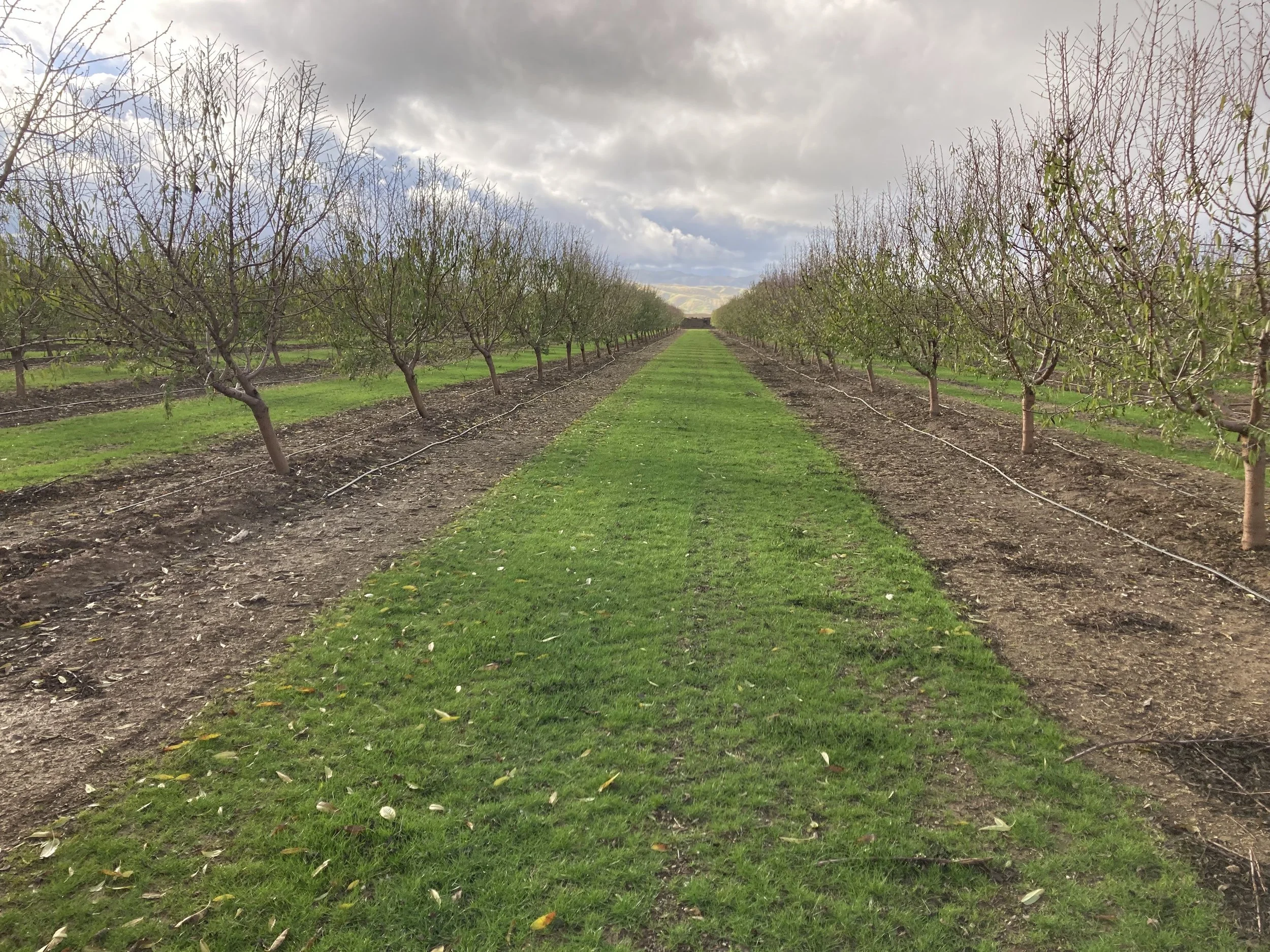
A few traits set it apart from a typical soil builder mix. Oakville bluegrass exhibits a low stature growth habit, which matters most for nut growers who sweep the orchard floor at harvest and don’t want residue from a high biomass cover. It activates during the cool season when moisture and temperatures line up. It also goes dormant during the growing season. Day length is the main trigger, generally around the first day of spring, though it carries a heat-driven dormancy as well, which California growers saw during the warm stretch this past March. Once it goes dormant, it doesn’t use resources like water or fertilizer through the heat of summer, and the top growth is nearly absent. That leaves the orchard floor underneath the trees mostly bare right when nut growers want it. It is also durable. In nearly a decade of growing it, the Columbia River Seed team has seen it green back up season after season, following summer dormancy.
2. Plant shallow, time it right
If there is one message to take from this conversation, it is proper seeding depth. Keep the seed shallow. Because the plant grows from a bulb, depth may be the single biggest factor for successful establishment. The odds go up sharply when the seed sits right on the surface, and going deeper than about an eighth of an inch will impact germination. Even a quarter inch has produced poor stands for experienced seed growers in side-by-side trials. A light rain after planting can turn what felt like a quarter inch behind the drill into a half inch overnight. Seed size and planting depth are important, and the top is always better for this grass variety.
The method that has produced the best stands is simple: loosen the top, broadcast, and pack it with a Brillion-type roller or something similar. Packing presses the bulb into firm contact with the soil without burying it. Pay attention to the soil at planting. On orchard soils that dry into a hard crust, a seed placed slightly too deep may never emerge. Working the ground too loose causes the same problem from the other direction, leaving air pockets and lets the bulb sink deeper than intended. Either way the seed ends up too deep. The goal is a firm, shallow seedbed that packs down well.
For this cool season grass, germination starts when overnight lows drop into the 40s and moisture is on the way, staying below a 50-degree ceiling. It has high cold and frost tolerance, so it can withstand multiple freeze events. Fog is not a concern either. The ideal planting window is late fall through November, before the northern winter solstice, so that seeds have time to germinate and establish roots before the shortest, coldest days of the year. Late plantings often disappoint. One grower who drilled seed in early February was underwhelmed, not because it failed, but because it ran out of runway before the days turned long and warm.
3. The first year is the whole game
Here’s the scoop: the first year can look unimpressive because it takes time for grass leaves and tillers to thicken and expand, nothing like the lush flush of an annual soil builder mix. That does not mean it failed. When grass comes up the first year, the stand often takes off in year two, filling in and sending up seed heads. The mistake to avoid is discing it under on the assumption that it did not work. That caution goes double for a late or deep planting, where a thin first-year stand can be expected.
The real job in year one is weed control, and it may be the number one factor for setting a stand up to succeed. Controlling broadleaf weeds is important for grass cover establishment. A single early broadleaf herbicide application, made in the window between roughly November 1 and February 1 while vines and trees are still dormant, will reduce competition and shading. Grasses are the harder fight. Some, like annual ryegrass and rattail fescue, resist much of the chemistry available, and there is no selective product that removes them without touching the bluegrass. Where weeds are racing up above a short stand, a single mowing down to the level of the bluegrass opens the canopy and buys the grass a few weeks without hurting it. Once the stand goes dormant, the options widen, and growers can bring in broader chemistry to clean up what is left, an approach even organic onion growers rely on in their own systems.
Pre-emergent herbicides deserve a careful word, because they cut both ways. There is an early, still-unproven idea that because bulbous grows from a bulb rather than a true seed, it may shrug off some pre-emergent chemistry that would stop other species in their tracks. A rough strip trial run through a new planting, using a common pre-emergent, left a visible lane with almost no Russian thistle or redstem filaree and the bulbous still standing. That is encouraging but far from conclusive, and a more rigorous trial is planned for this fall. The flip side matters just as much. Several growers who struggled to establish bulbous had a long history of pre-emergent use in the orchard, and lingering residue in the soil may have stunted or blocked the stand. Those same fields may also have been planted too deep, so it is hard to separate the causes. The takeaway for now is to know a field's pre-emergent history and factor it in, rather than assume a clean slate.
This establishment window is exactly what OBC is working to document. Through a SARE grant, we are partnering with a few producers on 10-acre plantings to capture the whole process, from pre-plant through coming out of dormancy in the second season, so growers have a clearer picture of what a strong first year actually looks like.
4. On diversity: establish first, mix in later
Growers almost always ask about biodiversity, and there is real enthusiasm for it at Columbia River Seed. With this particular grass, though, the honest guidance is to get the bluegrass established first, then drill in less competitive companions later. Anything green and aggressive growing right alongside it in the beginning can outrun it, and within a couple of seasons the bluegrass can disappear beneath it. That is its main vulnerability. Microclover is a good example. It spreads by stolons that root as they run, so a companion that starts out the size of a coffee cup can be the size of a coffee table a year later.
One Napa vineyard offers a real-world version of this. The grower put Oakville bluegrass down, mows for light weed control, and is happy with a stand that is mostly bluegrass with a few other things mixed in. He is not discing and re-buying cover seed every year the way his neighbors are, and he is seeing the soil benefits, including the water infiltration that comes from keeping living roots in the ground even after the top growth has gone dormant.
5. The economics, and how grant funding closes the gap
Seeding rate is where the money math gets interesting. OBC has recommended 75 to 150 pounds per acre, mostly as a hedge against weed pressure. Trials tell a more nuanced story. In ideal conditions, with good irrigation and a well-prepped seedbed, far less can work. One planting under a pivot succeeded on as little as 8 pounds per acre. Too heavy a rate can actually backfire, with the stand competing against itself and browning out in the heat.
Perennial seed still costs more up front than a quick annual mix, and that price difference is the barrier for many growers. But permanent cover can match the lifecycle of an orchard or vineyard, with no need to buy seed and replant every fall. Trading tilling for mowing takes less horsepower and fewer passes, and the payback comes sooner than the sticker price suggests.
This is where OBC's Advancing Markets for Producers grant takes the up-front cost off the table. It covers 100 percent of the seed cost for your first 10 acres, excluding tax and shipping. Benchmarked against Oakville bluegrass, that is roughly a $3,700 seed budget for those acres, plus an additional $100 per acre for the next 100 acres. Any qualifying perennial, permanent, or conservation cover mix works, including hard-seeded annuals you let reseed.
If you are weighing perennial cover for your orchard or vineyard, now is the time to sort out seed and logistics, especially with harvest running early this year. Browse Columbia River Seed to see what they offer, then reach out to find out whether the AMP grant fits your operation, and we will match your goals to a mix that works for your ground.