
Growing Cover with Pacific Coast Seed
We kicked off our Growing Cover: Lessons in Perennial Cover series with experts who understand perennial cover as well as anyone in California today. Julia Michaels, PhD is a restoration ecologist at Hedgerow Farms, a highly respected native seed producer. Joey Gonsalves, leads sales and business development for Pacific Coast Seed, and has been farming almonds, walnuts, and cattle on his own land for nearly 30 years. Together, they represent NativeSeed Group, a specialty seed company with nationwide reach and extensive resources and support for West Coast growers.
The goal of the series is to help vineyard and orchard growers develop a stronger understanding of opportunities and expectations when they’re getting off the annual cover crop treadmill, and choosing to put perennial, permanent cover on the ground. While our AMP grant funding support underwrites up to $13k in seed purchases, many growers are new to perennial cover cropping - it’s a shift that raises questions. What does success look like? How do I manage it? Will my perennial cover get in the way of harvest? Here is what we took away from the first session.
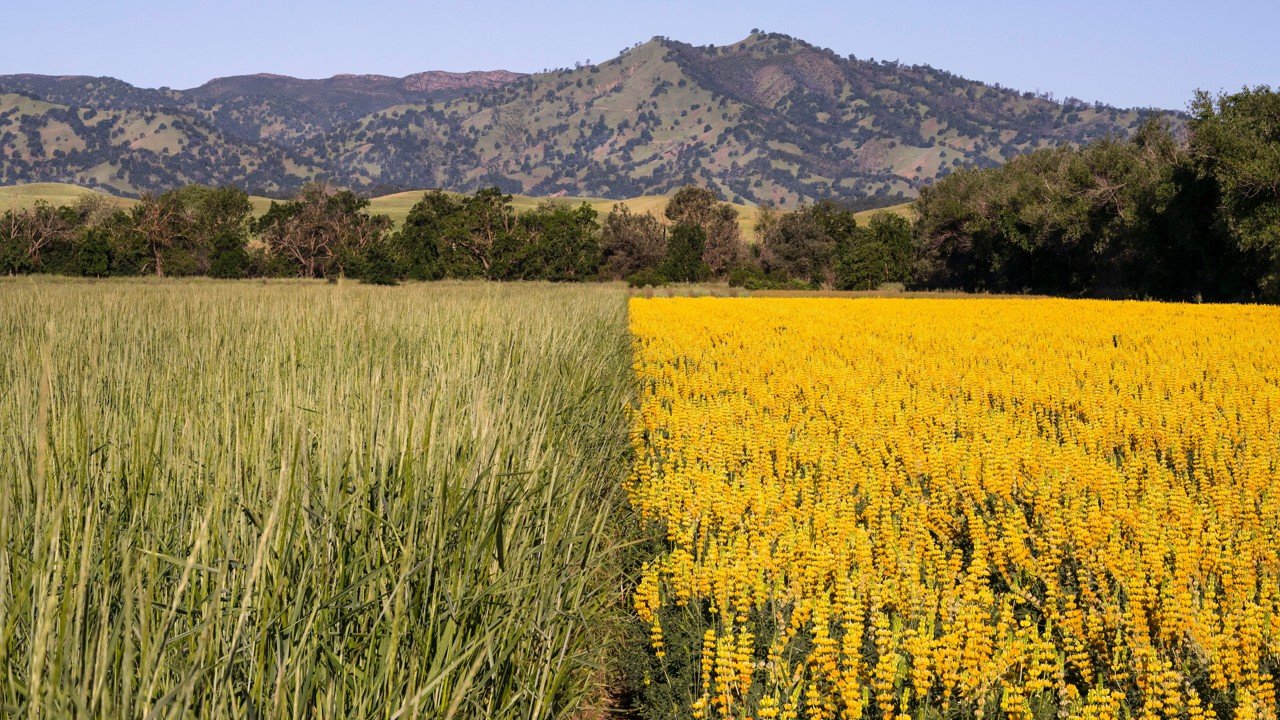
Perennial grasses growing next to annual lupine. Photo provided by Pacific Coast Seed.
Success with perennial cover looks different at first, and that is the point
It’s common to judge cover crop success by above ground biomass. An annual mix gives that big green flush fast, and that visual signal communicates that it’s working. Perennials work differently. They establish more slowly, and often with finer vegetation, because their energy goes into putting down roots first.
Think of the annuals as sprinters. These species race to vegetate and set seed before its short life is over. A perennial is running a marathon, in it for the long haul. If your new perennial stand looks unimpressive in the year one, it might be working exactly as intended.
This matters because one grower at the Burroughs Family Farms Regenerative Tree Nut Field Day summed up their cover crop goal as "roots over shoots." He wants the root mass, energy, diversity, and activity. He does not want to battle tons-per-acre of above ground vegetation.
Mowing is a valuable management tool
During establishment, and after a perennial stand is established, mowing is the best tool to favor and support it. Clipping back the vegetation a couple times during the “cover crop season” will tip the balance of growth toward desired species and will knock back annual weeds before they set seed.
A few practical notes from Julia and Joey:
- Keep the mower height up. Two to four inches is a good floor while plants are establishing. Cutting too low sets the stand back and slows regrowth.
- Start clean. Getting weeds under control before planting makes a real difference similar to establishing a stand of alfalfa. Mow really tight to the soil, or even “burn down” resident vegetation and weeds prior to seeding. Choose the practices that work for you.
- Do not be shy about mowing in the first year! Set the mower height to just barely trim the species you’re favoring, and those species will have a fighting chance.
Natives do not have to be expensive or dominant in your perennial cover
Native seed has a reputation for being pricey, and some of it is, especially species that are still hand collected in the wild. But there’s more to the story.
Julia shared that many of her go-to natives are grown on the farm, not collected wild, so the cost is far more reasonable than growers expect. A 100 percent native mix is not needed to get the benefit. Even a small percentage can establish, hold its ground, and add diversity over the years. In one orchard project, for example, a native that started at roughly 1.5 percent of the mix was still present three years later. It only added about 10 cents a pound to the cost.
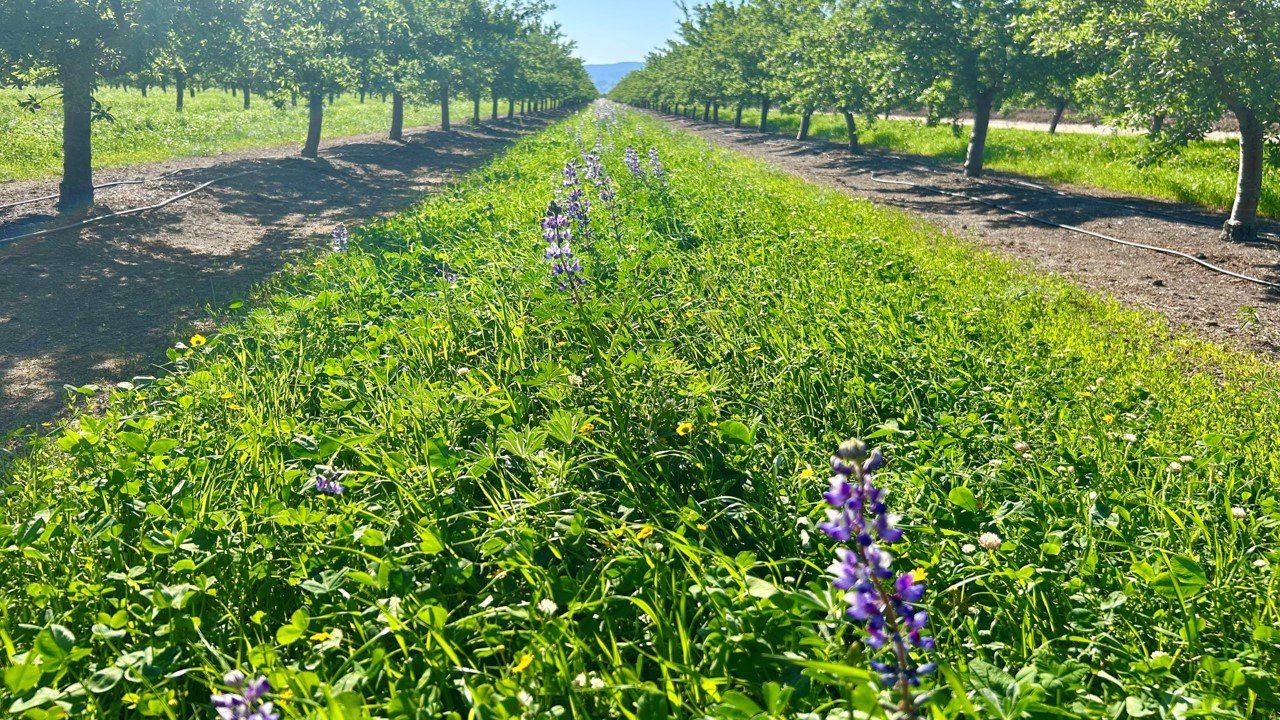
Native perennial grasses mixed with annual lupine in an orchard. Photo provided courtesy of Pacific Coast Seed.
Do you already have a resident species that you don’t want to tear out?
Some growers have permanent vegetation already and have not tilled or sprayed in years. They want to add intentional diversity without starting from scratch. That is absolutely workable. It is called overseeding, and the main requirement is good seed-to-soil contact, which often means a mow before seeding to open things up. AMP grant funding through OBC can be used for this!
A few words on seeding methods and pollinators
When selecting a conservation cover seed mix, one of the first questions to consider is: what kind of seeder will be used to plant it? Broadcasting is easier and more available, but some seed will land where it’s not intended and can change the seeding rates. Drill or drop seeding gives more control. OBC has no-till orchard and vineyard seeders available to growers. There are costs associated with using them, though, so plan for the method that best fits the operation. Mixes with very different seed sizes, from large legumes to tiny mustard, can be applied with the right handling and attention to soil type.
On pollinators, a quick honest note. Almonds bloom early, so a lot of the pollinator benefit in an almond orchard leans on annual species. A good pollinator mix extends the bloom window on either side of orchard bloom so the bees always have something to forage on. Consider mixing both annual pollinators and perennial cover in your orchard.
The honest take on getting started
Joey wears two hats, supplier and grower, and his perspective on adoption was one of the most useful parts of the conversation. The hurdle is usually not whether growers believe cover crops work. Most do. The hurdle is management: timing the planting, working around spray passes and harvest, and frankly, having one more program to track.
His advice is simple: try it. A covered, cooler orchard floor holds moisture better and creates a friendlier environment for the trees. Add in grant funding, for a low-risk way to test what works on your land before committing to it across the whole operation. Every farm is a little different, so part of the value of a good mix is that something in it will be well suited to your soil and your conditions.
Where OBC fits in
This is exactly what our AMP grant is built for. We can underwrite seed costs so you can put a thoughtful perennial mix on the ground this fall without it all coming out of pocket. And through this series, we are connecting growers directly with suppliers like Pacific Coast Seed who can build a mix around your crop, your budget, and your goals.
If you would like us to put you in touch, reach out any time at info@obc.ag.
The Bottom Line
Perennial cover asks you to change what success looks like in the first few years. It is slower and quieter above ground in the early going, because the real work is happening in the roots. Manage it with a higher mow and clean ground to start, lean on a smart mix rather than an all-native one, and use the AMP grant to try it without taking on all the risk yourself. Roots over shoots, one season at a time.