
Biochar in orchards: an early read
Part three of a series on biochar for orchard and vineyard growers
Part two looked at the field results from testing biochar in vineyards, where research has been conducted for more than a decade. Testing in almond orchards is at an earlier stage. Trials in California are ongoing and are built around soil, carbon, and water rather than yield. Orchards differ from vineyards in one key way: the volume of material they produce.
A burn ban with a byproduct
A 2003 state law, Senate Bill 705, put the San Joaquin Valley on a fixed schedule for phasing out open agricultural burning. New regulations banned agricultural burning for the majority of orchard prunings, field crops, and large orchard removals by 2010. On January 1, 2025, most of the remaining exemptions ended, including small orchard removals, vineyard removals, and surface harvested prunings. Only limited burning continues under narrow circumstances, mostly for diseased material.
This change left growers with a disposal question at a scale vineyards do not face. Roughly 40,000 acres of California almond orchards come out each year at end of life, producing an estimated 1.6 million tons of wood. The biomass co-generation facilities that once took that material have been closing steadily since 2015, and the plants still running take less orchard waste and pay less for what they take. Hulls and shells are separated off-site at hullers and shellers rather than burned in the field, but they push the industry's annual biomass to roughly 2.5 million tons, into markets that thinned as dairy demand fell. Both streams are potential feedstock. For orchard wood, most growers now grind it and work it back into the ground.
Recycling the orchard
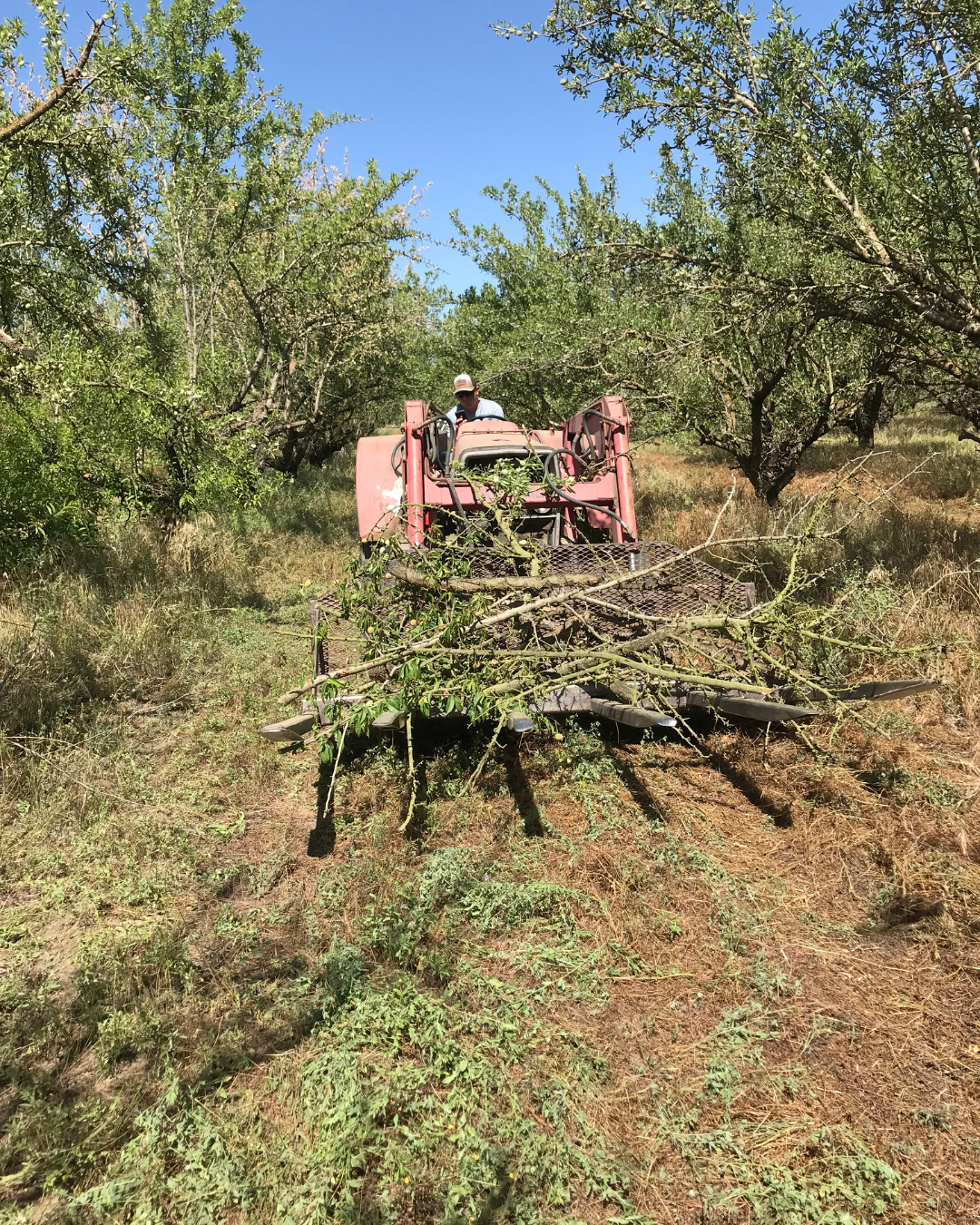
The method is simple: chip the old trees, spread the material, and incorporate it before replanting. The California Air Resources Board reports that more than 100,000 acres of almond and 10,000 acres of walnut have already been pulled, chipped, and returned to the soil. A nine-year study led by Amélie Gaudin's group at UC Davis, with Brent Holtz and colleagues from UC Cooperative Extension, compared recycled and burned plots at UC's Kearney research center in Parlier and found higher yields alongside gains in nutrient content, aggregation, porosity, and water retention. Irrigation water use efficiency rose 20%, and tree water status held up better under deficit irrigation. Nine years on, the recycled ground held about 4,500 pounds more carbon per acre in the top six inches.
There is a tradeoff, and the scale of the input explains why. Wood chips run about half carbon by weight, so a whole orchard grind puts roughly 54,000 pounds of carbon per acre into the ground, most of which cycles out rather than staying in the topsoil. It arrives with very little nitrogen attached, and soil microbes draw nitrogen from the surrounding soil to break it down. Growers manage the gap with supplemental nitrogen or manure at incorporation, and yields still came out ahead in the UC Davis work, but the nitrogen tie-up lands just as a replanted orchard is establishing.
That gap is part of why biochar is drawing attention in orchards.
The research so far
American Farmland Trust (AFT), UC Merced, and Pacific Farming Company are running trials in Madera County with biochar made from almond prunings and almond shells at two application rates. UC Merced is measuring soil greenhouse gas flux, soil moisture, plant-available nitrogen, and water infiltration. AFT is running the cost-benefit analysis.
Where the Madera trial tests biochar on its own, a UC Davis team is testing it alongside whole orchard recycling. On a 98-acre experimental orchard near Ceres, the old orchard is ground into the soil and almond shell biochar compost goes in with it, tracked through soil sampling and aerial multispectral and thermal imaging.
Charred wood and raw wood behave differently in soil. Pyrolyzed carbon is already stable, so it does not create the same demand for nitrogen that raw chips do. Its surface structure may also hold onto nitrogen that would otherwise move past the root zone, leaving more of a grower's supplemental N-application available to the trees. Composting the biochar first fills those surfaces with nutrients and microbes before it reaches the field, which is the same reasoning behind the compost and biochar blend in the Oasis vineyard trial. Whether any of this offsets the tie-up from a whole orchard grind is what the Ceres trial is measuring.
Madera has begun reporting, while the Ceres work is still early.
Early signals from Madera
The clearest result so far addresses carbon sequestration. After applying biochar made from almond shells and orchard prunings, Evelyn Perez-Agredano, the UC Merced graduate student who expanded the trial, and her team report “substantial sequestration” along with a decrease in methane emissions.
Soil change is showing up more gradually. Speaking at an October 2025 field day at the site, UC Merced agroecologist Rebecca Ryals, who leads the trial, said soil health benefits including water infiltration were beginning to appear in the treated plots.
One management recommendation has already come out of the work: apply the biochar wet. Wet biochar produces less dust, which reduces both pollution and health risks, and it lowers the combustion risk that dry biochar carries at high application rates. Safety training is still advised. Getting it onto the ground is its own problem, since a compost spreader proved inefficient in an orchard, particularly one with dry leaf litter.
Feedstock and temperature matter
Part two noted that feedstock and pyrolysis (when organic material is heated with little or no oxygen until it becomes a stable, carbon-rich solid) temperature change how biochar behaves. Separate laboratory work at UC Merced shows what that means for California orchard waste. The biochars tested there were made from almond shells, walnut shells, and almond tree clippings by slow pyrolysis at 300 to 350 degrees Celsius in a mobile pyrolyzer stationed at the farm, a range the researchers chose because it reflects what commercial operators are running. The material in the Oasis vineyard trial was fired above 600. Higher temperatures yield more stable carbon but less of it, with lower nutrient content, so a result from one material should not be read onto another.
The orchard grows its own feedstock, in volume, with fewer places to send it than a decade ago. Converting it takes a pyrolyzer. Part four turns to cost, the time it takes to break even, and what the carbon markets currently pay.